Preventive dental care is important throughout your life, no matter your age. By practicing good oral hygiene at home and scheduling regular checkups with your dentist, you can help keep your smile bright and healthy for many years to come. Here are a few simple ways that you can prevent the build-up of plaque and cavities:
- Brush your teeth at least twice a day with a soft-bristled toothbrush. Use fluoride toothpaste to remove food particles and plaque from the tooth surfaces. Also be sure to brush the top surface of your tongue; this will remove any extra plaque-causing food particles, and help keep your breath fresh!
- Clean between your teeth by flossing at least once a day. You can also use a mouthwash to help kill bacteria and freshen your breath. Decay-causing bacteria can linger between teeth where toothbrush bristles can't reach. Floss and mouthwash will help remove plaque and food particles from between the teeth and under the gum line.
- Eat a balanced diet, and try to avoid extra-sugary treats. Nutritious foods such as raw vegetables, plain yogurt, cheese, or fruit can help keep your smile healthy.
- Remember to schedule regular checkups with your dentist every six months for a professional teeth cleaning.
- Ask your dentist about dental sealants, protective plastic coatings that can be applied to the chewing surfaces of the back teeth where decay often starts.
- If you play sports, be sure to ask your dentist about special mouthguards designed to protect your smile.
If it's been six months since your last dental checkup, then it's time to contact our practice and schedule your next appointment!
Sealants
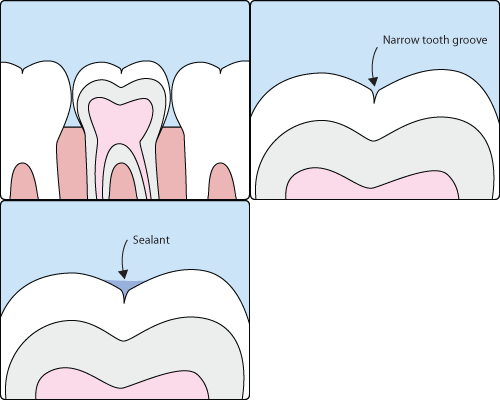
Sometimes brushing is not enough, especially when it comes to those hard-to-reach spots in your mouth. It is difficult for your toothbrush to get in between the small cracks and grooves on your teeth. If left alone, those tiny areas can develop tooth decay. Sealants give your teeth extra protection against decay and help prevent cavities.
Dental sealants are plastic resins that bond and harden in the deep grooves on your tooth's surface. When a tooth is sealed, the tiny grooves become smooth and are less likely to harbor plaque. With sealants, brushing your teeth becomes easier and more effective.
Sealants are typically applied to children's teeth after their permanent teeth have erupted as a preventive measure against tooth decay. However, adults can also receive sealants on healthy teeth. It is more common to seal permanent teeth rather than baby teeth, but every patient has unique needs, and your dentist will recommend sealants on a case-by-case basis.
Sealants typically last from three to five years, although it is fairly common to see adults with sealants still intact from childhood. A dental sealant only provides protection when it is fully intact so if your sealants come off, let your dentist know, and schedule an appointment for your teeth to be resealed.
Gum Disease
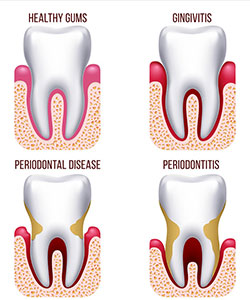
Gum disease, also known as periodontal disease, is an infection of the gums surrounding your teeth. Gum disease is one of the top reasons for tooth loss in adults, and because it is virtually pain-free, many patients do not know they have the disease. During each regular checkup, your dentist will check for signs of periodontal disease by measuring the space between your teeth and gums.
What causes gum disease?
Gum disease is caused by a buildup of plaque (a sticky form of bacteria that forms on the teeth). If the plaque is not removed (by flossing, brushing, and regular dental checkups), it will continue to build up and create toxins that can damage the gums. Periodontal disease forms just below the gum line and creates small pockets that separate the gums from the teeth. Periodontal disease has two stages: gingivitis and periodontitis.
- Gingivitis — This is the early stage of gum disease, when the gums become red and swollen, and bleed easily. At this stage, the disease is treatable and can usually be eliminated by daily brushing and flossing.
- Periodontitis — If left untreated, gingivitis will advance into periodontitis, and the gums and bone that support the teeth will become seriously and irreversibly damaged. Gums infected with periodontitis can cause teeth to become loose, fall out, or be removed by a dentist.
Certain factors can increase a patient's risk of developing periodontal disease, including:
- Smoking or using chewing tobacco
- Diabetes
- Certain types of medication such as steroids, anti-epilepsy drugs, cancer therapy drugs, calcium channel blockers, and oral contraceptives
- Bridges that no longer fit properly
- Crooked teeth
- Old fillings
- Pregnancy
While it is possible to have periodontal disease and not know it, some symptoms can include:
- Gums that bleed easily
- Red, swollen, tender gums
- Gums that have pulled away from the teeth
- Persistent bad breath or bad taste
- Pus between your teeth and gums
- Permanent teeth that are loose or separating
- Any change in the way your teeth fit together when you bite
- Any change in the fit of partial dentures
Treating Gum Disease
Treatments for gum disease can vary depending on the severity of each individual case. Typical treatments include:
- Non-surgical treatments such as at-home periodontal trays, and scaling and root planing (deep cleaning)
- Periodontal surgery and laser gum surgery
- Dental implants
Preventing Gum Disease
Regular dental checkups and periodontal examinations are important for maintaining your health and the health of your smile. You don't have to lose teeth to periodontal disease, and by practicing good oral hygiene at home, you can significantly reduce your chances of ever getting gum disease. Remember to brush regularly, clean between your teeth, eat a balanced diet, and schedule regular dental visits to help keep your smile healthy.
Extractions
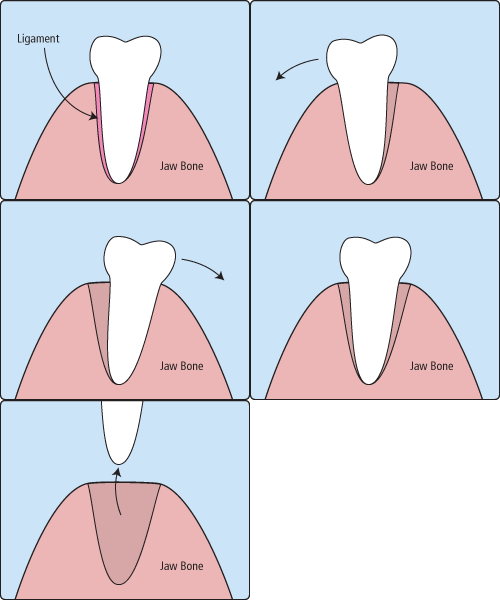
There are times when it is necessary to remove a tooth. Sometimes a baby tooth has misshapen or long roots that prevent it from falling out as it should, and the tooth must be removed to make way for the permanent tooth to erupt. At other times, a tooth may have so much decay that it puts the surrounding teeth and jaw at risk of decay, so your doctor may recommend removal and replacement with a bridge or implant. Infection, orthodontic correction, or problems with a wisdom tooth can also require removal of a tooth.
When it is determined that a tooth needs to be removed, your dentist will schedule another visit for this procedure, or refer you to an oral surgeon. The root of each tooth is encased within your jawbone in a "tooth socket," and your tooth is held in that socket by a ligament. In order to extract a tooth, your dentist must expand the socket and separate the tooth from the ligament holding it in place. While this procedure is typically very quick, it is important to share with your doctor any concerns or preferences for sedation.
Once a tooth has been removed, neighboring teeth may shift, causing problems with chewing or with your jaw joint function. To avoid these complications, your dentist may recommend that you replace the extracted tooth.
Nightguards
If you often wake up with jaw pain, earaches, or headaches, or if you find yourself clenching or grinding your teeth, you may have a common condition called bruxism.
Although the causes of bruxism are not really known, several factors may be involved. Stressful situations at home, school, or work, problems in sleeping, an abnormal bite, and crooked or missing teeth may contribute to bruxism. Many people do not even know that they grind their teeth, as it often occurs when one is sleeping. If not corrected, bruxism can lead to broken teeth, cracked teeth, damaged restorations, or even tooth loss.
There is an easy, non-invasive treatment for bruxism: nightguards. Nightguards are an easy way to prevent the wear and damage that teeth-grinding cause over time. Custom-made by your dentist from soft material to fit your teeth, a nightguard is inserted over your top or bottom arch and prevents contact with the opposing teeth.
Choosing the right mouthguard is essential. There are three basic types of mouthguards: the pre-made nightguard, the “boil-and-bite” nightguard, and a custom-made nightguard from our office. When you choose a nightguard, be sure to pick one that is tear-resistant, comfortable and well fitted for your mouth, easy to keep clean, and does not prevent you from breathing properly. A nightguard created in our office will fit all these requirements, as it will be custom-made just for your teeth.